
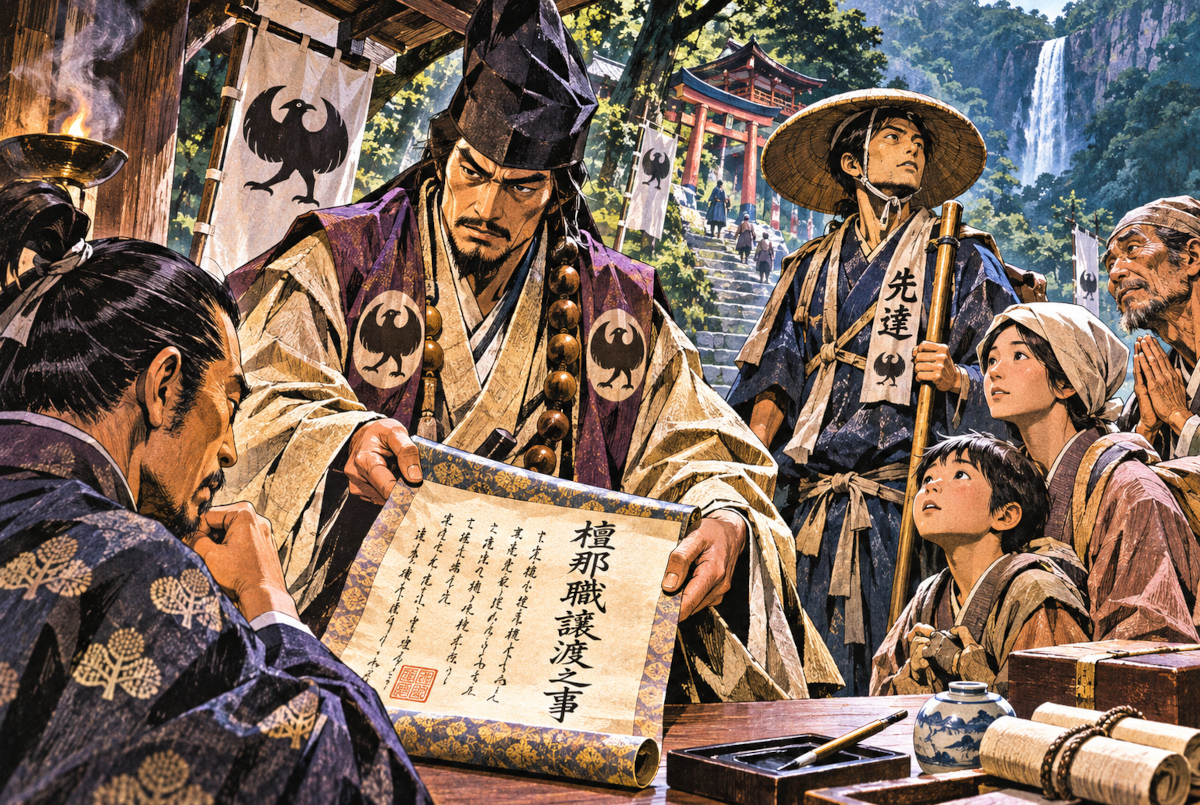
Gods don’t come with price tags. But in medieval Japan, the right to serve people who believed in them sometimes did.
In 1468, an oshi—a religious figure associated with the Kumano pilgrimage—sold the rights connected with serving the Hirayama family of Musashi Province for 4 kan and 500 mon, a substantial amount recorded in medieval currency.
Were believers being sold? Not quite. What changed hands was the right to maintain an established religious relationship and potentially earn income through prayers, pilgrimage arrangements and other services.
And this was no isolated curiosity. Historical documents record other sales of similar rights. Somehow, a relationship built around religious faith had become an asset that could be bought and sold.
At Kumano, Even the Right to Serve Pilgrims Could Be Owned
For centuries, the Kumano sacred sites on Japan’s Kii Peninsula attracted pilgrims. Members of the imperial family and the aristocracy made journeys there during the Heian period (794–1185), and warriors from eastern Japan increasingly joined them during the Kamakura period (1185–1333).
Travel was difficult. Pilgrims needed guides who understood the mountain routes and religious practices.
Two kinds of religious specialists played important roles. Sendatsu guided pilgrims on their journeys, while oshi associated with the Kumano shrines arranged prayers, lodging and other assistance at the destination.
At first, these relationships were tied to particular visits. Over time, however, some became lasting arrangements between religious specialists and particular families, clans or communities.
The right to serve those religious patrons became known as danna-shiki.
According to the official History of Tama City, income associated with prayers and accommodation helped turn these relationships into valuable interests. Danna-shiki rights could be inherited, transferred or sold.
The people themselves were not property. What was traded was the right to maintain an ongoing relationship with them and receive income associated with religious services.
That distinction matters. Danna-shiki was not simply a modern customer list. It combined religious responsibilities, established patronage relationships and economic interests within the institutions of medieval Japan.
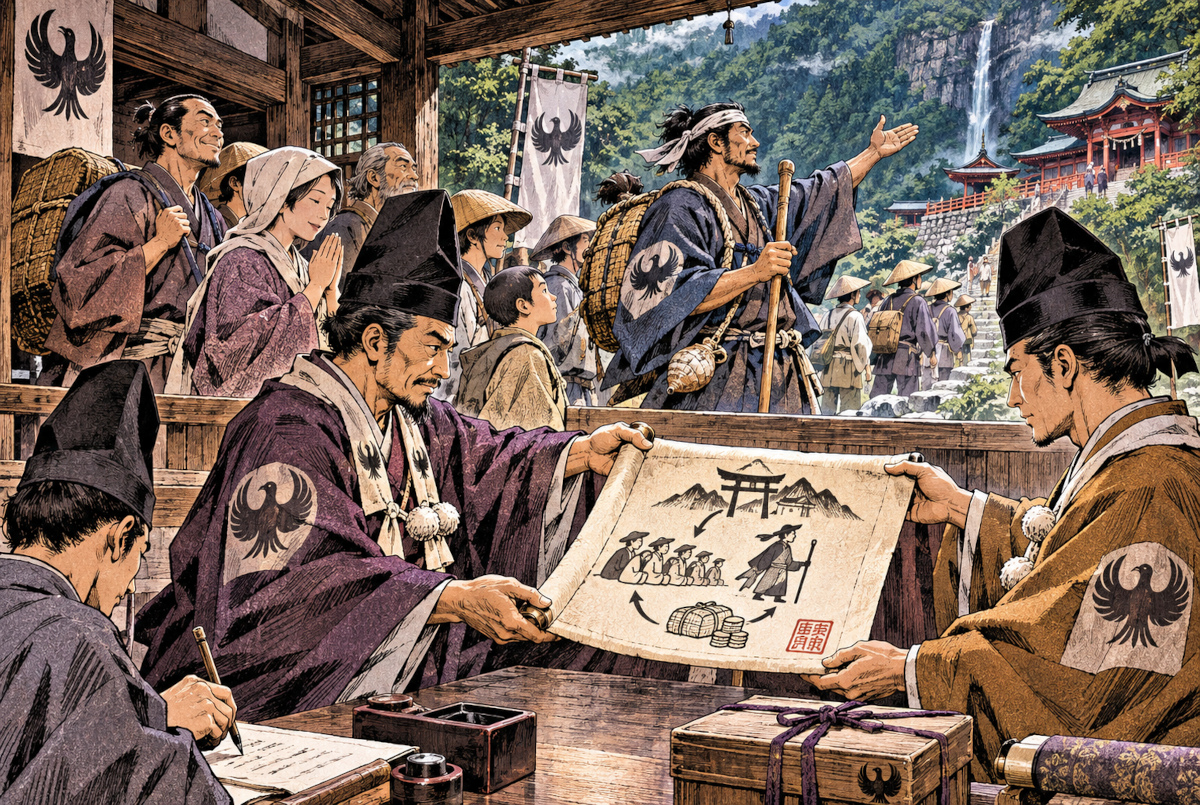
AI-generated conceptual illustration of relationships among Kumano oshi, pilgrimage guides and religious patrons. The rights being transferred concerned the provision of religious and pilgrimage services, not ownership of the pilgrims themselves. The people, costumes, banners, illustrated scroll and shrine buildings are artistic interpretations rather than exact reconstructions of historical evidence.
From 700 to 4,500 Mon: What Did the Surviving Contracts Actually Say?
Two municipal histories, those of Kitamoto and Tama, preserve particularly revealing examples of danna-shiki transactions associated with Musashi Province, an old province covering parts of present-day Tokyo, Saitama and Kanagawa.
I converted the recorded prices into the same monetary unit, mon, to compare four transactions.
In these records, 1 kan of coinage equals 1,000 mon.
| Year | Patrons or territory covered | Recorded sale price |
|---|---|---|
| 1356 | Kawagoe, Tsunoda and Edo families | 1 kan 300 mon (1,300 mon) |
| 1468 | Hirayama family of Musashi Province | 4 kan 500 mon (4,500 mon) |
| 1501 | Oda family of Musashi Province | 700 mon |
| 1504 | Patrons associated with several sendatsu in Musashi Province | 3 kan (3,000 mon) |
The 1468 transaction is especially striking.
A deed dated November 24, 1468, cited in the History of Tama City identifies the seller as a woman named Akuri associated with Jōkeibō, an oshi establishment at Kumano Nachi. The transaction concerned the danna-shiki rights associated with the Hirayama family.
We have not just a general statement that religious patronage was valuable. We have a documented transaction, an identifiable seller, a group of patrons and a specific price.
Now compare the highest and lowest figures in the table:
4,500 ÷ 700 = approximately 6.43
The highest recorded price among these four examples was about 6.43 times the lowest.
But here is the trap. That does not mean a Hirayama believer was worth 6.43 times as much as an Oda believer.
The four transactions concerned different families, patronage networks and dates. The documents do not establish a consistent price per worshipper, nor do they tell us how many years a buyer needed to recover the purchase cost.
What they do establish is that established religious patronage relationships could be traded for specific amounts of money.
That is remarkable enough without pretending that medieval believers had a universal market price.
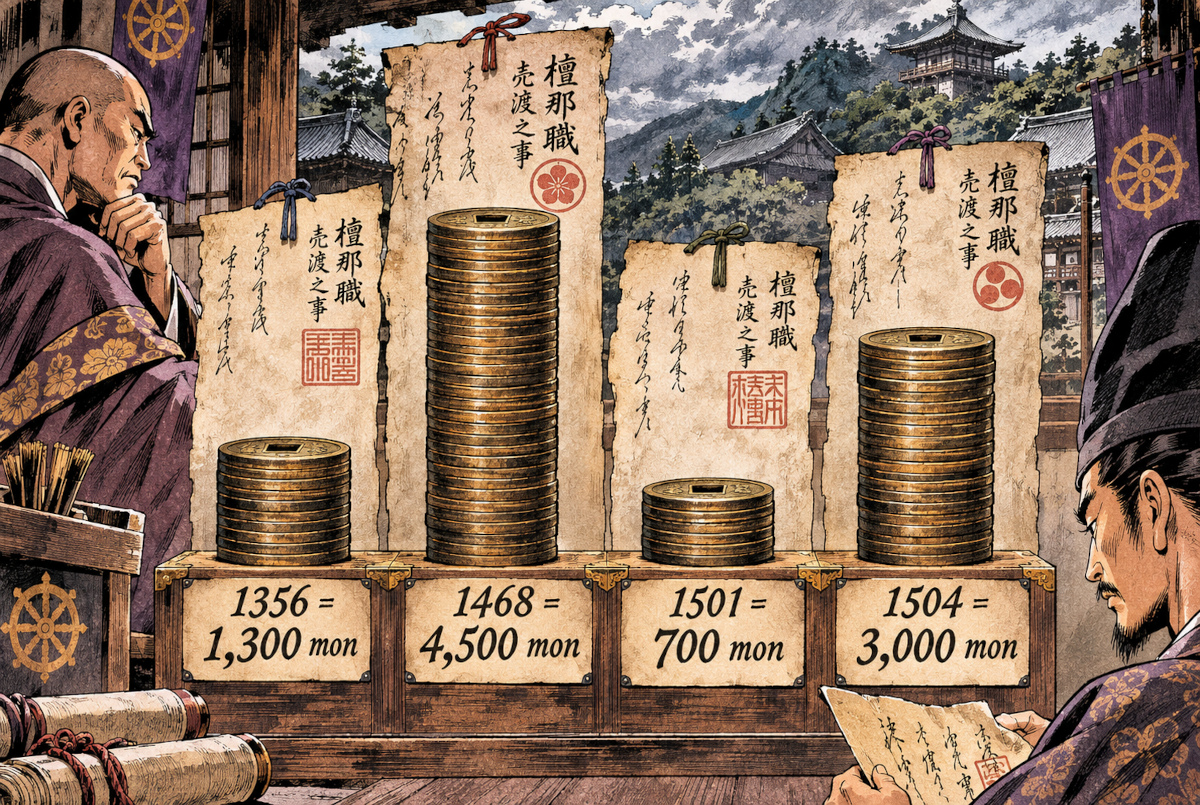
AI-generated comparison based on transactions documented in the histories of Kitamoto and Tama. The four prices are 1,300 mon in 1356, 4,500 mon in 1468, 700 mon in 1501 and 3,000 mon in 1504. Each transaction covered different patronage rights; the figures are not prices per individual believer or a continuous market-price series. The coin stacks indicate relative size but are not drawn to an exact scale. The documents and seals are artistic representations.
Ise Grand Shrine Built a Nationwide Network of Religious Patrons
Kumano was not the only place where religious specialists developed lasting relationships with worshippers.
During Japan’s Edo period (1603–1868), the oshi associated with Ise Grand Shrine maintained extensive networks of households across the country. At Ise, these religious specialists were traditionally called onshi.
They or their representatives visited assigned districts, distributed shrine talismans and Ise calendars, performed or arranged religious services, and received offerings.
When members of their patron households traveled to Ise, the oshi could accommodate them in their own residences, arrange kagura performances and guide them to the shrine’s Inner and Outer Sanctuaries.
In modern business language, the arrangement resembles a combination of recurring customer relationships, religious services, travel assistance and hospitality.
That is an analogy, of course. An Edo-period shrine organization was not literally a modern travel agency.
Ise Grand Shrine’s official historical account states that more than 2,000 oshi were active during the Edo period.
It also cites the Gekū Shishoku Dankata Kasū Aratamechō, a historical register of households associated with the Outer Shrine’s religious specialists.
The reported figure is extraordinary: 4,218,584 registered patron households, described by the shrine as equivalent to 89% of Japan’s households at the time.
But another official source gives a different number.
Why Do Two Official Ise Sources Differ by About 740,000 Households?
The Jingu Museum’s description of an artwork titled Ise Daidai Kagura no Zu, depicting a kagura ceremony at an oshi residence, states that in 1777 there were 453 oshi residences and approximately 4.96 million patron households.
Compare that with the 4,218,584 figure published on Ise Grand Shrine’s official history page.
Using 4,960,000 as the approximate museum figure:
4,960,000 − 4,218,584 = 741,416 households
That is a difference of roughly 740,000 households. The museum’s figure is approximately 1.18 times the figure given on the shrine’s history page.
These calculations are straightforward, but their interpretation is not.
The published descriptions do not establish that both figures refer to precisely the same year, geographical coverage, registration method or treatment of overlapping patronage relationships.
Because the museum gives an approximate figure, the calculated difference should also be treated as approximate.
The discrepancy is real in the published descriptions, but it does not by itself prove that either institution made an error.
There is another distinction worth making. A count of registered patron households is not a count of individual pilgrims. It is not a census of people who personally believed in the shrine’s deities, either.
Therefore, the claim that patron-household registrations represented 89% of all households should not be rewritten as “89% of Japanese people worshipped at Ise.”
Even allowing for uncertainties in the records, figures running into the millions reveal the enormous reach of these religious relationships.
The medieval Kumano contracts and the Edo-period Ise household network represent different institutions and historical situations. They should not be treated as a single organization evolving unchanged across centuries.
What they share is an important economic principle: a continuing relationship between religious specialists and worshippers could acquire substantial financial value.
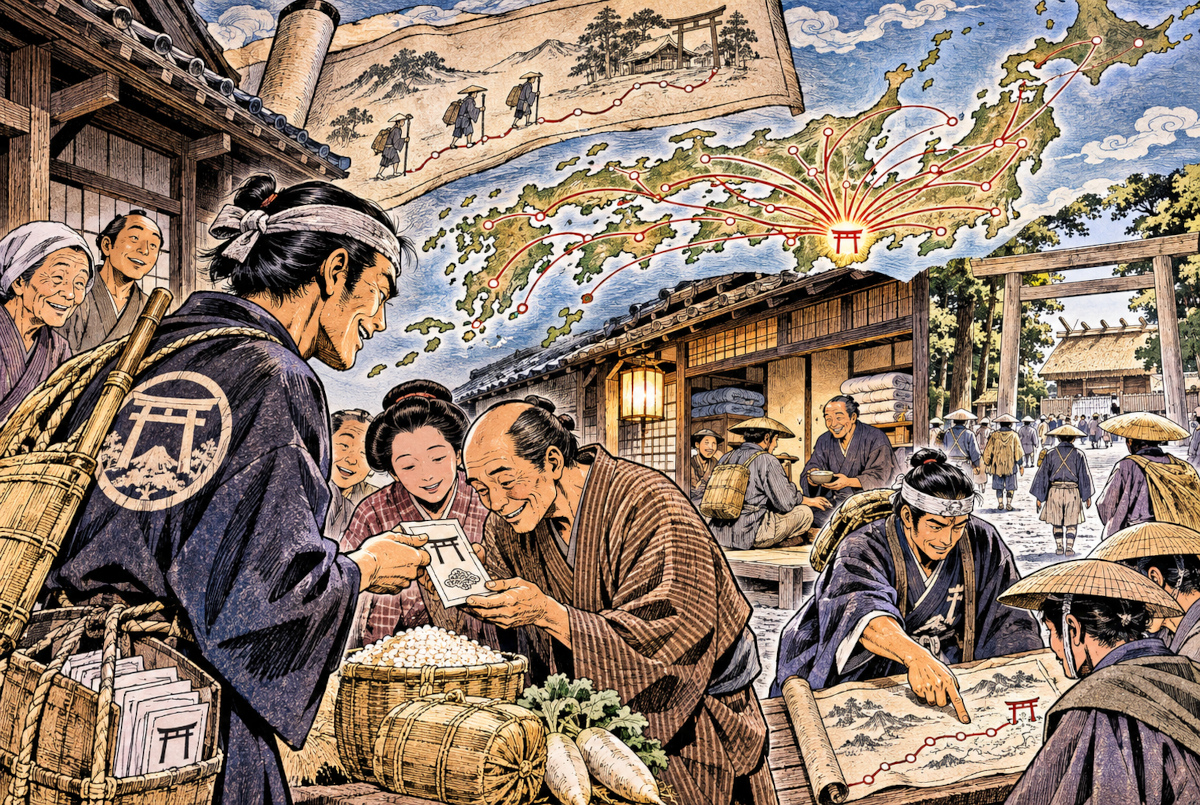
AI-generated illustration combining the activities of Ise oshi during the Edo period: visiting patron households, distributing shrine talismans, receiving offerings and helping pilgrims with accommodation and shrine visits. The map and red connecting lines are conceptual, not verified historical service territories, travel routes or political boundaries. The figures, buildings and talisman designs are artistic interpretations.
Who Actually Turned Religious Devotion Into a Business?
Look at these records together, and a particular structure emerges.
First, a sacred place attracts people who consider it worthy of worship. Religious specialists help those people travel, pray and maintain their connections with the shrine.
Some of those connections become lasting relationships with particular families or communities. Eventually, the rights associated with serving those patrons can become economically valuable—and, as the Kumano documents show, transferable property.
None of this proves that religious specialists invented their gods or manufactured devotion purely for profit.
Their services also had practical value. Pilgrims needed guidance, accommodation and access to religious ceremonies, especially when a journey could be difficult and expensive.
But the records leave little doubt that religious relationships could be turned into financial assets.
There was eventually a major institutional break. In 1871, during the Meiji government’s reforms of Ise Grand Shrine, the traditional oshi system was abolished.
Religious devotion did not disappear. The institutional arrangement that had allowed these specialists to maintain their established patronage networks, however, came to an end.
Editor’s Note
I don’t believe in gods or Buddhas. But I have to admit that the people who built businesses around religious devotion could be remarkably inventive.
When I first came across these transactions, I wondered whether people had literally been sold.
No. The paperwork concerned the right to serve them and benefit from that continuing relationship.
And there it was: 4,500 mon, written into a medieval transaction.
The supposed power of a deity cannot be reduced to a reliable number. But the economic value of a relationship with the people who worshipped that deity? Apparently, someone was perfectly happy to put a price on it.
I suspect that once a religious figure or sacred place gathers enough devoted followers, someone eventually works out how to organize the relationship. Responsibilities become regular work, the work supports an institution, and the institution may acquire assets worth transferring.
Was the whole arrangement planned from the beginning? The evidence doesn’t tell us that.
But it certainly became a business.
So who deserves more credit for the historical impact: the gods themselves, or the people who turned devotion into a nationwide economic network?
As someone who doesn’t believe in divine intervention, I find the second group far more impressive.
Are Shrines and Temples Businesses? — Seven-Part Series
Faith, donations, land, lending, and religious authority. From the construction of Nara's Great Buddha to modern religious finances, this seven-part investigation examines how money and religion became intertwined in Japan.
- Part 1: Belief Is Free. Building a Giant Buddha Isn’t: Nara’s 2.6 Million Mystery (Part 1)
- Part 2: Money for the Dead, Loans for the Living: Medieval Japan’s Temple Lenders (Part 2)
- Part 3: A Price Tag on Believers? Kumano’s 4,500-Mon Patronage Deal (Part 3)
- Part 4: English edition Coming soon
- Part 5: English edition Coming soon
- Part 6: English edition Coming soon
- Final Part: English edition Coming soon
Terms That May Need a Quick Explanation
- Sendatsu (先達)
- Religious guides who led pilgrims to sacred sites such as Kumano, helped with travel arrangements and instructed them in religious practices. Many were associated with the mountain-ascetic tradition known as Shugendō.
- Oshi / Onshi (御師)
- Religious specialists associated with Japanese shrines and temples who maintained relationships with pilgrims and patrons, arranging prayers, lodging and other services. The reading onshi is particularly associated with Ise, while oshi is used in the Kumano context. Their roles varied by period and location.
- Danna-shiki (檀那職)
- The rights associated with serving particular religious patrons, families or communities. In medieval Kumano, these patronage rights could be inherited, transferred or sold. They did not constitute ownership of the people involved.
References
- Tama City Library — History of Tama City, General History Volume 1, “Kumano Faith” (Japanese). Historical discussion of Kumano pilgrimage guides, oshi and danna-shiki, including transactions dated 1468, 1501 and 1504.
- Kitamoto Digital Archives — History of Kitamoto City, Historical Documents of the Ancient and Medieval Periods, “Deed of Sale of Danna Rights” (Japanese). Transcription and commentary on a December 8, 1356, contract involving a sale for 1 kan and 300 mon.
- Ise Jingu (Ise Grand Shrine) — “History of Jingu” (Japanese). Official account of the historical activities of the oshi and the register listing 4,218,584 patron households, described as 89% of households at the time.
- Jingu Museum — “Ise Daidai Kagura no Zu” (Illustration of the Great Kagura at Ise) (Japanese). Museum collection description giving 453 oshi residences and approximately 4.96 million patron households for 1777.
- Mie Prefecture — “Former Oshi Office Investigation Records” (Japanese). Official historical explanation of talisman distribution, patron-household relationships, pilgrimage lodging and the abolition of the oshi system in 1871.
- Mie Prefectural Museum (MieMu) — “Ise Pilgrimage and the Oshi,” Permanent Exhibition (Japanese). Museum explanation of assigned districts, the distribution of talismans, hospitality at oshi residences and pilgrimage assistance.