
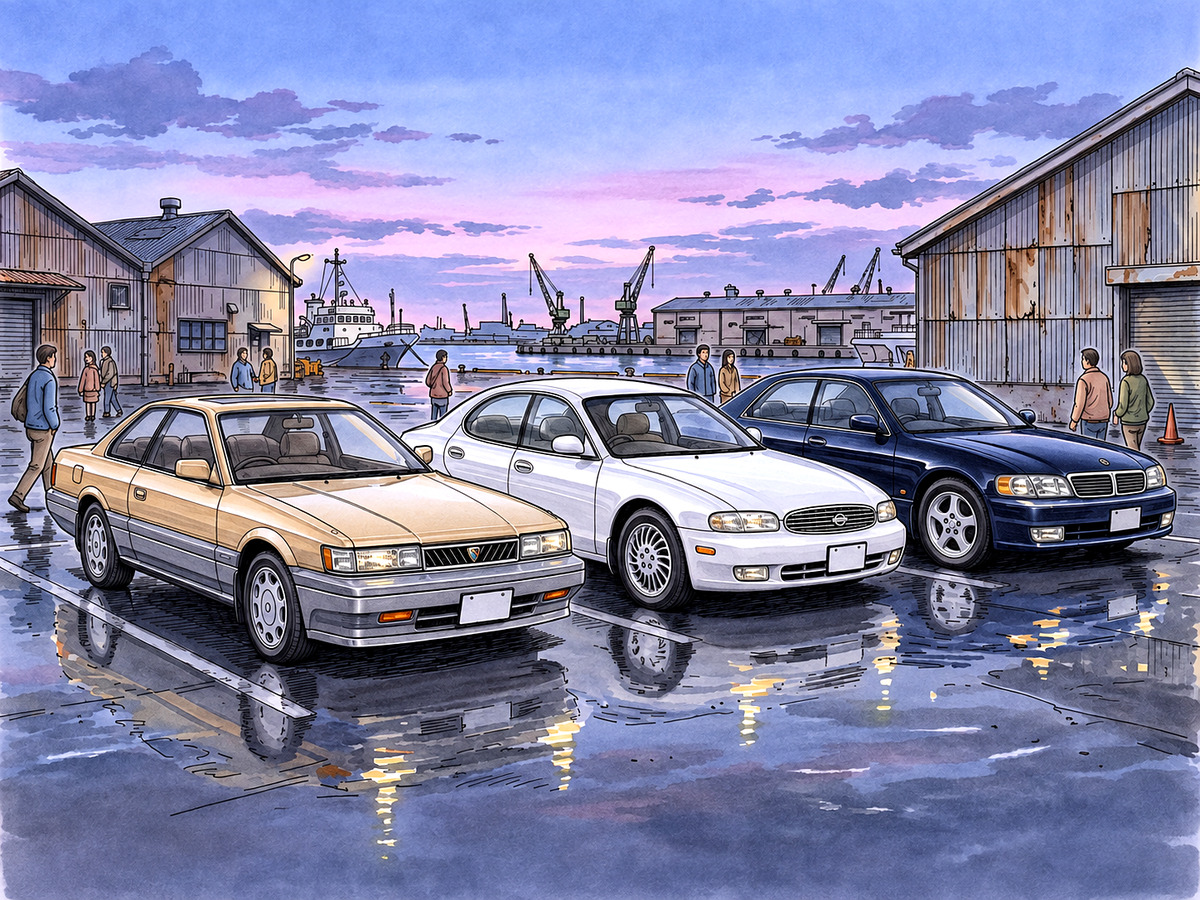
In June 1992, the Nissan Leopard stopped being a two-door coupe. The angular F31, made famous in Japan by the television detective series Abunai Deka, was replaced by a rounded four-door luxury sedan called the Leopard J. Ferie.
Four years later, the Leopard changed direction again, becoming a close relative of Nissan’s Cedric and Gloria luxury sedans.
Then something rather curious turned up in the specifications. Comparing the 1996 Nissan Leopard XV with the Gloria Gran Turismo Ultima reveals that both cost ¥3.95 million, produced 270 PS and weighed exactly 1,580 kg.
The Leopard, once struggling to compete with the Toyota Soarer, had somehow ended up competing with other Nissans.
1992: The Leopard Was No Longer Just a Japanese Luxury Car
The J. Ferie, which succeeded the F31 Leopard, was a luxury sedan based on the Y32 Nissan Cedric and Gloria. Nissan’s official heritage records also identify its North American counterpart: the Infiniti J30.
Its downward-sloping tail, rounded bodywork and British-inspired interior represented a radical departure from the angular F31 coupe.
| Specification | F31 Ultima Turbo (Facelift) | J. Ferie Type L | J. Ferie Type X |
|---|---|---|---|
| Introduction year | 1988 | 1992 | 1992 |
| Number of doors | 2 | 4 | 4 |
| Engine | VG30DET | VG30DE | VH41DE |
| Displacement | 2,960 cc | 2,960 cc | 4,130 cc |
| Induction | Turbocharged | Naturally aspirated | Naturally aspirated |
| Maximum power | 255 PS | 200 PS | 270 PS |
Power figures are expressed in metric horsepower (PS), as specified in the Japanese vehicle catalogs.
The flagship Type X even received the 4.1-liter V8 also used in the Nissan Cima, one of Nissan’s upper-tier luxury sedans. Whatever one might think of its styling, the J. Ferie was hardly a downgrade in terms of luxury or engineering ambition.
Rather than treating it as a conventional successor to the F31 coupe, it makes more sense to see the J. Ferie as a new luxury car developed with North America in mind, carrying over the existing Leopard name.
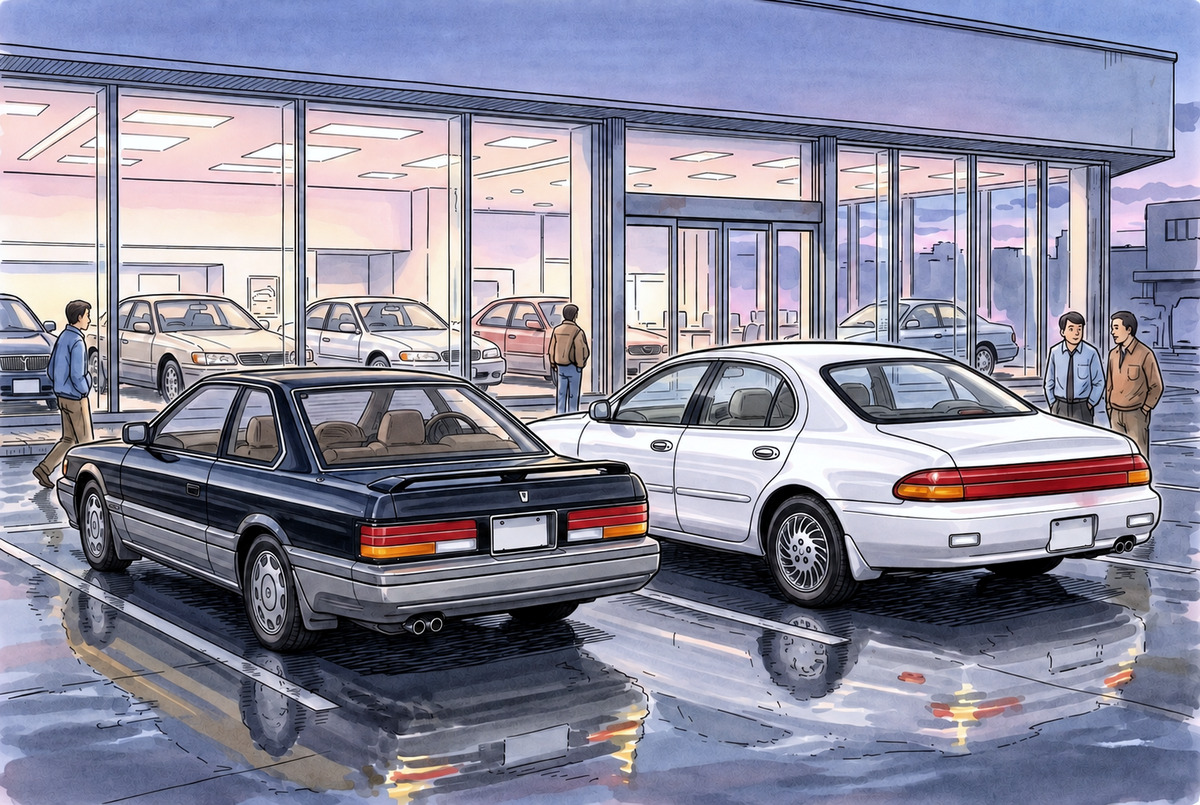 An artistic comparison of the facelifted F31 Leopard coupe (left) and the four-door J. Ferie (right). Some lighting and exterior trim details have been simplified.
About 7,300 Cars in Japan, but More Than 20,000 in America in a Single Year
In Japan, the J. Ferie’s commercial failure is often blamed on its unusual, downward-sloping rear end. But the sales figures from North America complicate that explanation.
| Market and model | Reporting period | Vehicles sold |
|---|---|---|
| Japan: Nissan Leopard J. Ferie | Entire model run | Approx. 7,300 |
| United States: Infiniti J30 | 1992 | 13,774 |
| United States: Infiniti J30 | 1993 | 21,494 |
| United States: Infiniti J30 | 1992–1993 combined | 35,268 |
Sources: The Japanese total is an approximate figure reported by Best Car Web. US sales figures come from Nissan’s North American sales data published by the Los Angeles Times on January 10, 1994. Reporting periods, market sizes, prices and engine lineups differ, so these figures should not be treated as a like-for-like comparison of sales performance.
In 1993 alone, US sales of the J30 were approximately 2.94 times the J. Ferie’s entire Japanese sales total. Combining 1992 and 1993 raises that multiple to approximately 4.83.
Furthermore, the J30 outsold Infiniti’s flagship Q45, which recorded 12,255 US sales in 1993.
The Infiniti J30, which shared its basic design with the J. Ferie, found a market in the United States. Poor sales in Japan alone are not enough to establish that the car was a worldwide failure.
Sales figures cannot tell us whether American buyers particularly liked its styling. Market size, pricing, brand positioning and Japan’s post-bubble economy were all different.
Nevertheless, blaming the entire outcome on that unusual rear-end design seems a little too convenient.
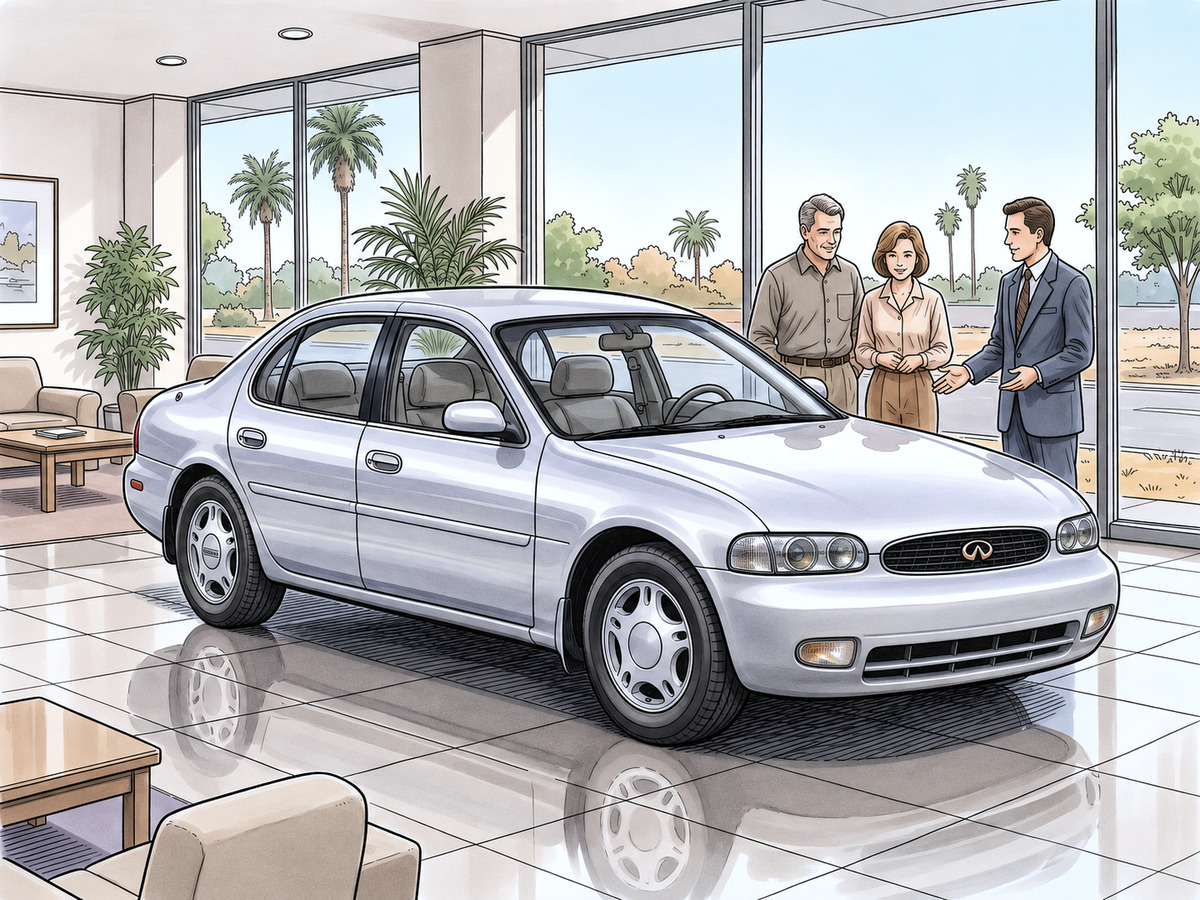 An artistic depiction of an Infiniti J30 showroom in the United States around 1993. The illustration does not represent an actual dealership.
1996: What Exactly Separated the Leopard from the Gloria?
The fourth-generation Leopard arrived in March 1996. Nissan dropped the J. Ferie name and adopted the basic architecture of the Y33 Cedric and Gloria.
The result was what Japanese manufacturers commonly called a : a luxury sedan with a sleeker roofline and frameless door glass.
To see how much the Leopard’s position had changed, consider two similarly timed models with exactly the same original list price.
| Specification | Nissan Leopard XV | Nissan Gloria Gran Turismo Ultima |
|---|---|---|
| Introduction date | March 1996 | June 1995 |
| Model code | E-JHY33 | E-HY33 |
| Original list price | ¥3,950,000 | ¥3,950,000 |
| Engine | VQ30DET | VQ30DET |
| Displacement | 2,987 cc | 2,987 cc |
| Maximum power | 270 PS | 270 PS |
| Maximum torque | 37.5 kgf·m | 37.5 kgf·m |
| Vehicle weight | 1,580 kg | 1,580 kg |
| Overall length | 4,895 mm | 4,875 mm |
| Overall width | 1,765 mm | 1,765 mm |
| Overall height | 1,425 mm | 1,425 mm |
| Wheelbase | 2,800 mm | 2,800 mm |
| Interior dimensions (L × W × H) | 2,000 × 1,480 × 1,160 mm | 2,000 × 1,480 × 1,160 mm |
| Fuel economy (Japanese 10–15 test cycle) | 8.6 km/L | 8.6 km/L |
| Drivetrain | Rear-wheel drive | Rear-wheel drive |
| Transmission | 4-speed automatic | 4-speed automatic |
| Weight-to-power ratio | Approx. 5.85 kg/PS | Approx. 5.85 kg/PS |
Comparison of the standard specifications at each model’s introduction. Prices are contemporary Japanese catalog list prices. The weight-to-power ratio was independently calculated by dividing 1,580 kg by 270 PS. Matching specifications do not imply identical equipment, interior or exterior finishes, or driving characteristics. The Japanese 10–15 fuel economy test cycle is a historical laboratory measurement, not an EPA rating.
The price difference? Zero yen. The power difference? Zero PS. Even the vehicle weight and interior dimensions were identical.
The difference in overall length was just 20 mm, or approximately 0.41% relative to the Gloria’s length.
Of course, the Leopard had its own front and rear styling, along with differences in equipment and finishes. They were not literally the same car. But given how closely their prices and basic specifications matched, explaining the Leopard’s distinctive purpose through the numbers alone becomes surprisingly difficult.
The car that had once challenged the Toyota Soarer was now competing on virtually the same ground as another Nissan luxury sedan.
 An artistic comparison of the 1996 Nissan Leopard XV (left) and the 1995 Gloria Gran Turismo Ultima (right). Some factory equipment and exterior details have been simplified.
The Final Leopard Had Not Given Up on Performance
It would nevertheless be unfair to dismiss the Y33 Leopard as nothing more than a restyled Cedric or Gloria.
The October 1997 facelift introduced the 230 PS VQ30DD V6. Nissan also offered a four-wheel-drive version powered by the 235 PS RB25DET turbocharged inline-six.
| Selected engines | Maximum power | Configuration |
|---|---|---|
| VG20E | 125 PS | 2.0-liter naturally aspirated V6 |
| VQ25DE | 190 PS | 2.5-liter naturally aspirated V6 |
| VQ30DD | 230 PS | 3.0-liter direct-injection V6 |
| RB25DET | 235 PS | 2.5-liter turbocharged inline-six, 4WD |
| VQ30DET | 270 PS | 3.0-liter turbocharged V6, RWD |
Selected engines offered during the Y33 Leopard’s model run. Not all were available at the original launch.
From a modest 125 PS engine to a 270 PS turbocharged V6, the most powerful version produced 2.16 times as much power as the least powerful engine listed above. Buyers could even choose between rear-wheel-drive and four-wheel-drive configurations.
There was plenty to appreciate from an engineering perspective. Yet such a broad range also raises another question: who, exactly, was the Leopard supposed to appeal to?
The more versatile the car became, the less obvious its individual identity seemed to be.
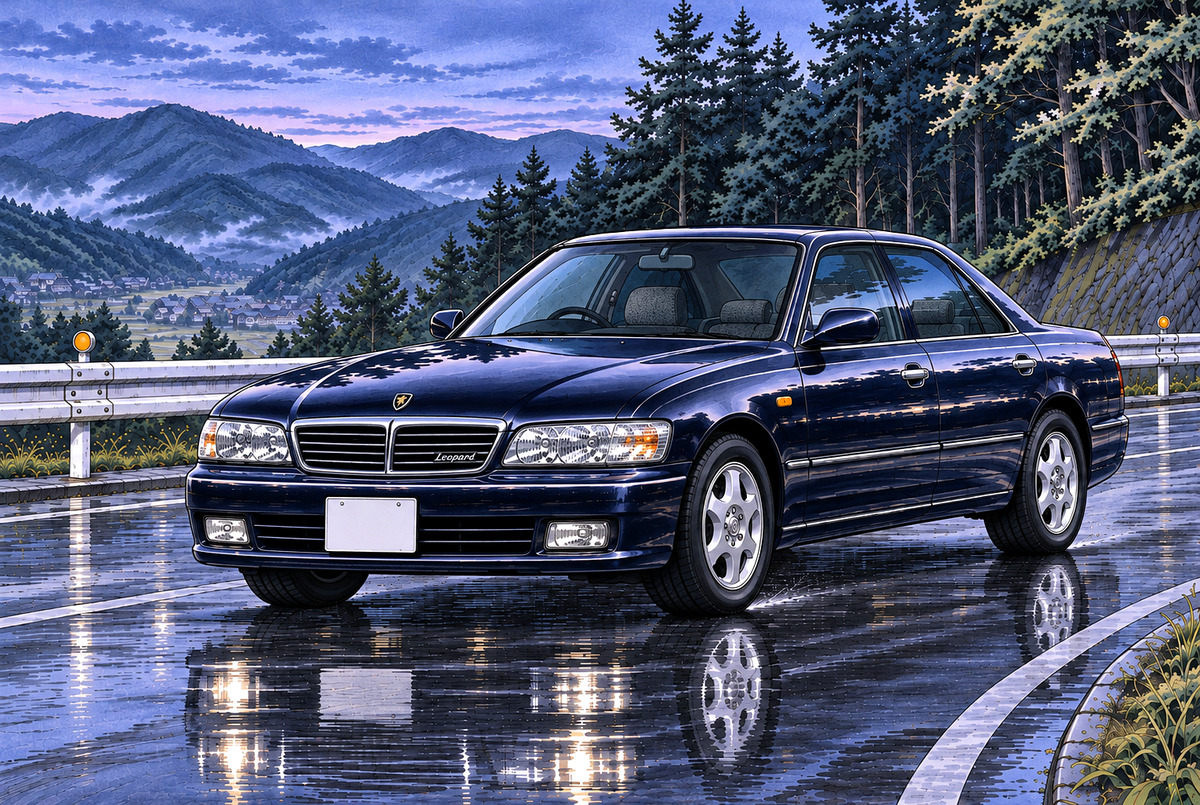 An illustration inspired by the facelifted Y33 Nissan Leopard. It is not a technical representation of the XJ FOUR’s drivetrain or trim-specific equipment.
Did Carlos Ghosn Really Kill the Nissan Leopard?
Any discussion of Nissan’s financial crisis in the late 1990s inevitably brings up its alliance with Renault in 1999 and the Nissan Revival Plan associated with Carlos Ghosn.
But comparing those events with the Leopard’s reported production end date reveals an interesting discrepancy in the timeline.
| Date | Event |
|---|---|
| March 1999 | Nissan and Renault enter a capital alliance |
| June 28, 1999 | The new Y34 Nissan Cedric and Gloria are launched |
| June 1999 | Reported end of Y33 Leopard production |
| October 18, 1999 | The Nissan Revival Plan is announced |
| December 2000 | End of the Leopard’s model period according to some vehicle catalog databases |
| February 2003 | First-generation Nissan Teana launched |
Sources disagree on the Leopard’s exact end date. Meisha Cultural Research Institute reports that production ended in June 1999, while GAZOO also lists June 1999 as the end of the model period. Carsensor lists the production-model period through December 2000. Nissan’s primary records establishing the precise final production and final retail sale dates have not been located.
Nissan’s official announcement for the Y34 Cedric and Gloria, published in June 1999, outlined a policy of assigning one model to each individual brand identity.
To distinguish the Cedric and Gloria more clearly, Nissan also abandoned their previous Brougham and Gran Turismo series structure.
In other words, Nissan was already reorganizing its luxury-car lineup before the formal announcement of its October restructuring plan.
The Nissan Revival Plan subsequently proposed reducing the number of domestic from 24 to 15, and eventually to 12. That final target represented a 50% reduction.
It has not been possible to establish who made or participated in the specific decision to discontinue the Leopard.
However, if the June 1999 production end date is correct, attributing the car’s disappearance directly to the restructuring plan announced in October is difficult to reconcile with the chronology.
That does not rule out the possibility that management decisions made after the Renault alliance, but before the plan’s formal announcement, contributed to the outcome.
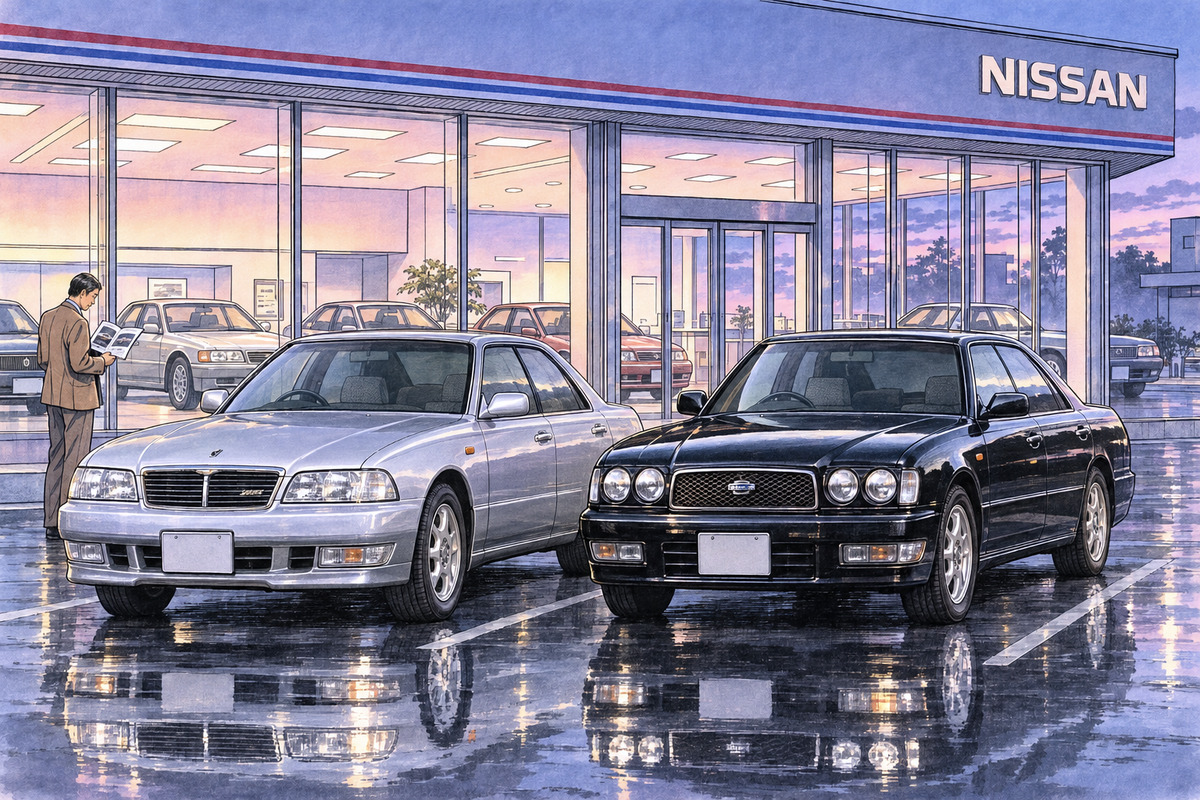
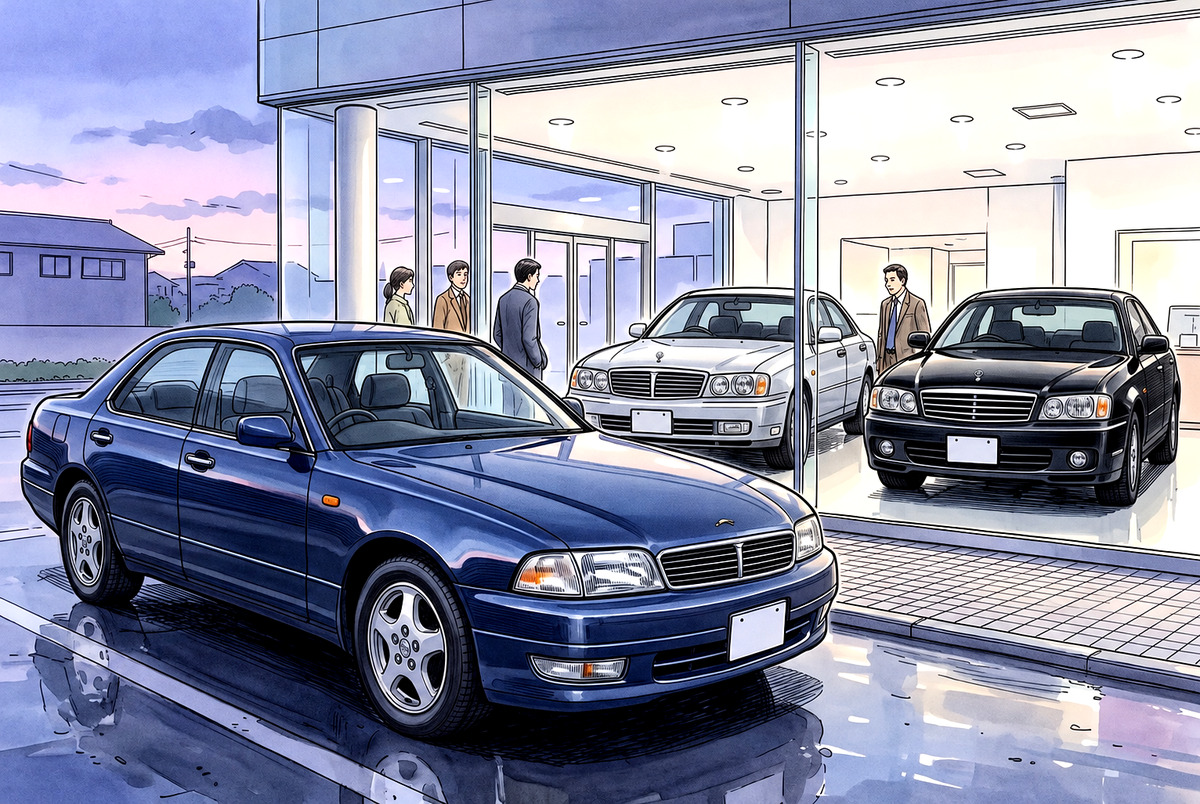 An imagined showroom scene illustrating the changes in Nissan’s luxury-car lineup in 1999. It is not a historical record of an actual dealership or launch event, and some vehicle details have been simplified.
Both Manufacturers Looked Overseas, but Toyota Kept the Soarer Coupe
Which brings us back to the Leopard’s old rival, the Toyota Soarer.
According to Toyota’s official corporate history, the third-generation Z30 Soarer, introduced in 1991, was also developed with the North American luxury-car market in mind, specifically as an addition to the Lexus lineup.
| Period | Nissan Leopard | Toyota Soarer |
|---|---|---|
| Late 1980s | F31: two-door coupe | Z20: two-door coupe |
| Early 1990s | J. Ferie: four-door sedan | Z30: two-door coupe |
| Late 1990s | Y33: four-door hardtop | Z30: two-door coupe |
| 2001 | No successor carrying the Leopard name | Z40: two-door convertible |
| 2005 | Leopard name remains discontinued | Transitions to the Lexus SC430 in Japan |
Both Nissan and Toyota were targeting overseas luxury-car markets. But while Nissan transformed the Leopard into a sedan, Toyota continued to offer the Soarer as a two-door personal luxury car.
Nissan’s official heritage records explain that the Leopard’s role as a personal sedan was later taken over by the Teana. The Teana, however, was not introduced as a direct next-generation Leopard.
The role of the luxury sedan survived. But the Leopard as a two-door personal luxury car had effectively disappeared back in 1992.
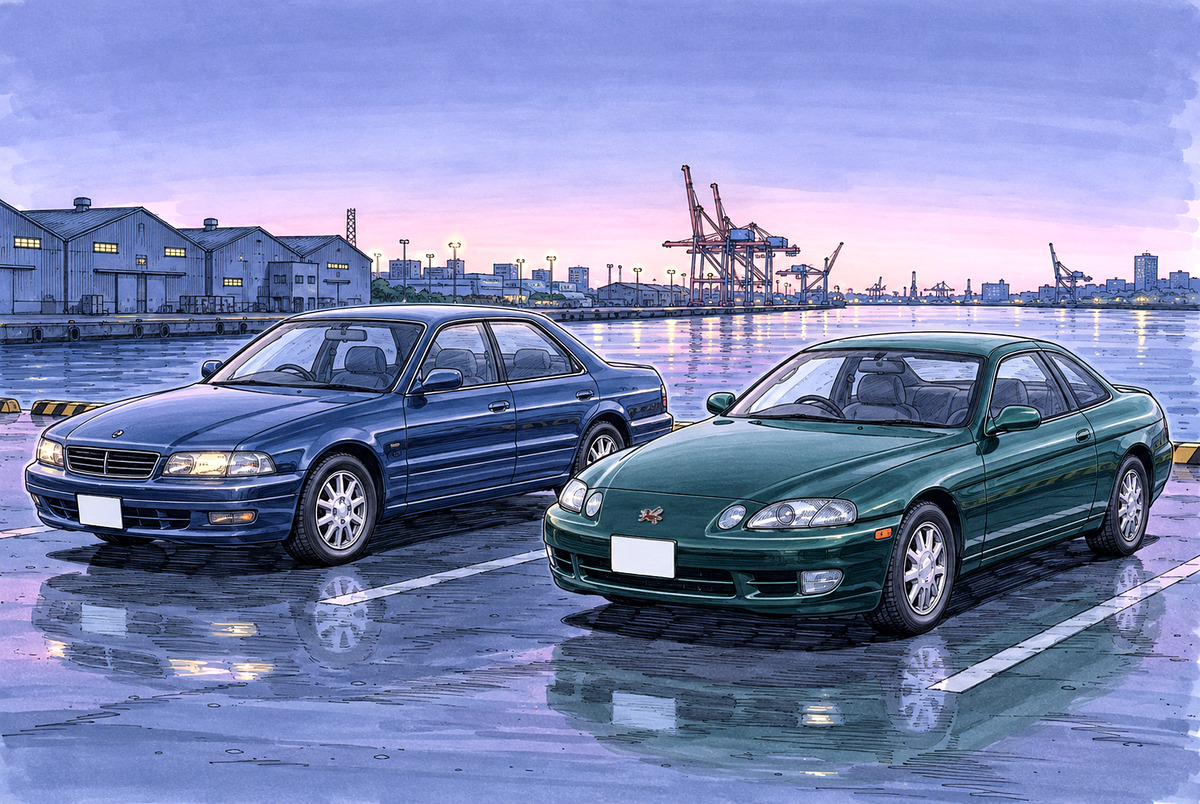 An artistic comparison of the Leopard, which became a four-door luxury car, and the Soarer, which retained its two-door configuration.
Editor’s Note
As a longtime Nissan enthusiast, I have nothing against the J. Ferie’s V8 or the Y33’s 270 PS turbocharged V6. In fact, I would quite happily own either of them today.
But here’s the thing. Would I spend ¥3.95 million on a Leopard or exactly the same amount on a Gloria? Even as a Nissan fan, I’d have trouble explaining which one I should buy and why.
The Soarer, by comparison, had a much clearer identity. If you wanted a luxury sedan, Toyota already had the Crown or the Celsior, the Japanese-market counterpart of the Lexus LS.
Perhaps the problem was not that the Leopard lacked the ability to compete with the Soarer. Perhaps Nissan had simply changed who the Leopard was supposed to compete against.
What disappoints me most is not that the final Leopard lacked performance. It had 270 PS, after all. It’s that Nissan stopped making the kind of Leopard that could still be called the Soarer’s rival.
Nissan Leopard: Five-Part Series
The Nissan Leopard arrived before the Toyota Soarer, yet struggled to match its rival in the Japanese market. Across five articles, we examine sales figures, engine performance, pricing, technology, the influence of Abunai Deka, and the Leopard's changing identity through 2000.
- Part 1: How Did the Nissan Leopard Outsell the Soarer in One Class—Yet Lose Overall?
- Part 2: Did a 2.0L Toyota Soarer Really Beat Nissan’s 3.0L Leopard?
- Part 3: Why Did the Nissan Cima Get the Leopard’s 255-PS Turbo Engine First?
- Part 4: Did the Nissan Leopard Finally Beat the Toyota Soarer? The Abunai Deka Effect
- Final Part: Why Did the Nissan Leopard Give Up Being a Coupe? Two ¥3.95 Million Nissans and the End of an Icon
References
- Nissan Heritage Collection: Leopard XS-II — Official heritage information on the F31 generation’s transition to a two-door coupe and its basic model positioning. (Japanese)
- Nissan Heritage Collection: Leopard J. Ferie Type L — Official information on the Y32-based architecture, North American Infiniti J30 counterpart, exterior design and engine configuration. (Japanese)
- Goo-net: Nissan Leopard J. Ferie Model and Grade Catalog — VG30DE and VH41DE engine specifications and grade configurations. (Japanese)
- Best Car Web: Japanese Cars That Failed to Achieve Their Commercial Potential — Source for the approximate Japanese sales total of 7,300 J. Ferie vehicles. (Japanese)
- Los Angeles Times: While Others Sputter, Nissan Races Forward (January 10, 1994) — Contemporary reporting of Nissan’s North American sales figures by model for 1992 and 1993. (English)
- Nissan Heritage Collection: Leopard XR — Fourth-generation model architecture, engine development and the later transfer of its market role to the Teana. (Japanese)
- GAZOO: Nissan Leopard XV, March 1996 Model — Original list price, engine output, vehicle weight and dimensions used in the comparison. (Japanese)
- MOTA: 1996 Nissan Leopard 3.0 XV Specifications — Detailed vehicle specifications, including interior dimensions. (Japanese)
- GAZOO: Nissan Gloria Gran Turismo Ultima, June 1995 Model — Original list price and vehicle specifications used for comparison with the Leopard XV. (Japanese)
- Meisha Cultural Research Institute: Nissan Leopard — Development background, equipment, additional engines and the reported June 1999 production end date. (Japanese)
- Carsensor: Nissan Leopard, March 1996–December 2000 Model — Vehicle catalog model period, which differs from the end dates reported by other sources. (Japanese)
- Nissan Motor Co.: Nissan Launches the All-New Cedric and Gloria (June 28, 1999) — Official announcement covering the Y34 model lineup and differentiation between the two models. (Japanese)
- Nissan Motor Co.: Nissan Announces the Nissan Revival Plan (October 18, 1999) — Official restructuring announcement covering production systems and platform consolidation targets. (Japanese)
- Nissan Motor Co.: 90th Anniversary Corporate History — Nissan’s financial difficulties in the 1990s and its capital alliance with Renault. (Japanese)
- Toyota Motor Corporation, 75 Years of Toyota: Third-Generation Soarer — Official vehicle history explaining the development strategy for the North American Lexus market. (Japanese)
- Toyota Motor Corporation, 75 Years of Toyota: Fourth-Generation Soarer — Official history of the 2001 model change and the transition to the Lexus SC430 in Japan in 2005. (Japanese)
- GAZOO: Nissan Leopard Ultima V30 Twin Cam Turbo — Specifications of the facelifted F31 Leopard. (Japanese)
- GAZOO: Nissan Leopard, March 1996–June 1999 — Catalog model period for the fourth-generation Leopard. (Japanese)
- GAZOO: Nissan Leopard XJ FOUR — Specifications of the 235 PS four-wheel-drive version introduced in October 1997. (Japanese)